
by Abi Perrin & Stuart Capstick
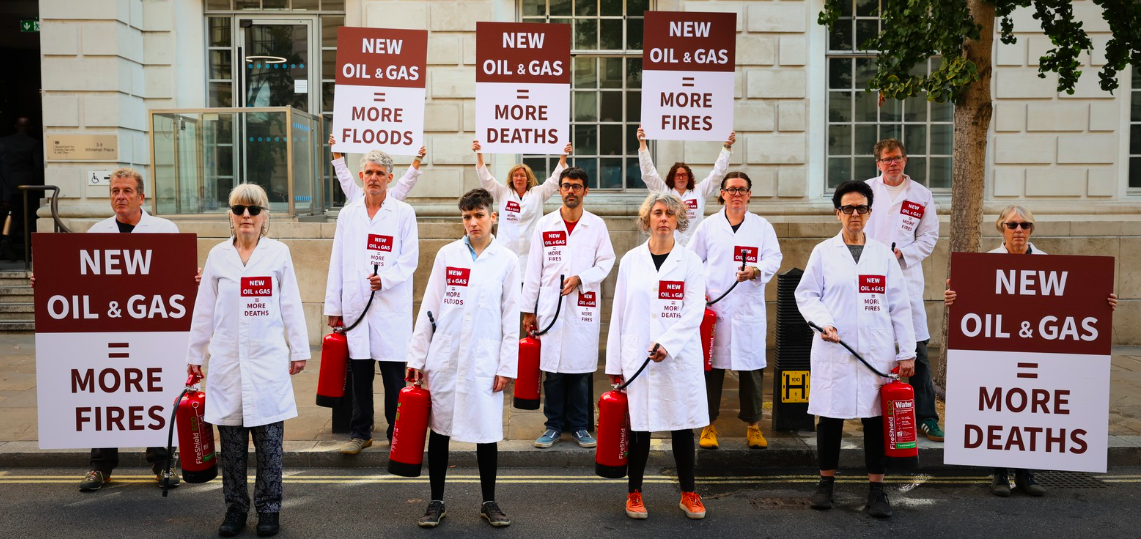
On August 17th, a group of scientists from Scientists on Survival took part in an action outside the UK Government's Department for Energy Security and Net Zero, to highlight the dangers and harms from permitting further oil and gas drilling.
Photo by Kirk Pritchard
The statements we use in our public actions have to be short and punchy, designed to encapsulate aspects of the scientific consensus about unfolding climate risks. They are stated as starkly, plainly and urgently as we can make them. At the same time, as scientists, we recognise that these statements must be supported by evidence. Here we share short explanations of the statements we have used, as well as links to further evidence that supports them.
Background
Greenhouse gas emissions, caused by humans, are causing average temperatures on Earth to increase. This is plain fact, supported by huge amounts of evidence and scholarship.
The rise in average temperatures has happened extremely rapidly since coal, oil and gas have been used at scale. Burning these fossil fuels is the biggest contributor to global heating and the resulting climate emergency.
"The evidence is clear that fossil fuels—and the fossil fuel industry and its enablers—are driving a multitude of interlinked crises that jeopardize the breadth and stability of life on Earth"
Extreme weather events are amongst the most noticeable symptoms of the climate emergency. Technical approaches known as 'attribution science' allow us to estimate how much more likely, more frequent and/or much intense global heating has made these extreme events. For example, a recent study provided evidence that fossil fuel emissions have rapidly worsened European heatwaves, concluding the extreme heat observed in June 2026 was "tens to hundreds of times more likely" than it would have been in 2003 and would have been "virtually impossible just 50 years ago".
Statement 1: New oil & gas = more fire
Global heating creates the hotter, drier conditions that makes fires more likely take hold, spread faster and burn longer.
Attribution studies have demonstrated that fossil-fuelled global heating has already made deadly wildfires much more likely. This includes detailed reports on the fires in Spain and Portugal, Turkiye, Cyprus and Greece and more widely across Europe in 2025.
"We found that human-caused climate change was a key driver of the fire weather conditions, primarily through its influence on exceptionally high temperatures, but also by exacerbating drought conditions"
World Weather Attribution on European wildfires (2026)
NASA data shows that extreme wildfires are getting bigger, more frequent and more intense. This trend is expected to continue as carbon emissions drive hotter and drier conditions in many parts of the world.
Statement 2: New oil & gas = more floods
Global heating increases the likelihood and impact of flooding by fuelling extreme rainstorms and rising sea levels.
A warmer atmosphere can hold more moisture, thus creating the conditions for heavier, more intense rainfall. Hotter oceans also fuel more intense tropical cyclones
"In Jamaica, we find that heavy 5-day rainfall events such as the one associated with Melissa are about 30% more intense and about twice as likely in today’s climate, that is 1.3°C warmer than it would have been without human-induced climate change. In Eastern Cuba the observations show an even stronger increase of about 50% in intensity and a factor 9 in frequency".
- World Weather Attribution on Hurricane Melissa (2025)
Ice melt and thermal expansion of the oceans is also causing sea levels to rise. This makes low-lying nations and coastal cities - including some of the biggest population centres on Earth - particularly vulnerable. Even under relatively conservative projections, large areas of major cities (including London) are expected to be below the annual flood level before 2050.
New oil & gas = more deaths
In addition to directly deadly extreme heat, fires and floods, global heating compromises the supply and accessibility of essential resources and services, including food, drinking water and healthcare.
"Climate change is increasingly destabilising the planetary systems and environmental conditions on which human life depends."
Climate impacts kill, and no part of the world is immune to them anymore, as the recent heatwaves here in the UK have shown.
"More than 2,700 people are thought to have died from heat-related causes during the May and June heatwaves in England and Wales. Of those, it’s estimated that 42% died as a result of the extra heat caused by human-induced warming."
Met Office (2026)
Each extreme fire, flood, or heatwave comes with deadly, immediate costs to people and wildlife. Even so, the indirect, systemic impacts can be worse still. To give just one example, food security risks are mounting fast with climate impacts liable to compromise some of the worlds most important 'bread basket' regions all at once.
With so many variables at play across a complex, interconnected Earth system and so many possible courses our societies could choose to take, estimating loss of life due to climate impacts - especially those set to occur in the future - is far from straightforward. That said, even conservative estimates are terrifying: projections range from tens of millions to several billions of human lives expected to be lost from climate impacts, even in the near term (by 2050).
Using a 'Mortality Cost of Carbon' metric that attempts to estimate the temperature-related excess deaths that will be caused this century by today's carbon emissions, tens of thousands of lost lives can be ascribed to the new oil production currently being considered by the UK government.
"The analysis found that Rosebank alone could be linked to approximately 57,400 excess heat deaths globally over its lifetime – more than the number of babies born in Scotland in a year."
Oxfam (2026)
Note: Burning fossil fuels is also the biggest contributor to air pollution, which results in millions of deaths each year.
And so...
To fight the fires, hold back the tides and protect lives it is now extremely urgent - more so than ever before - that we:
Stop making the problem worse. This requires the UK government to show courage and leadership and to face down vested interests who wish to maximise their profits from the extraction and sale of fossil fuels. It requires cutting greenhouse gas emissions as fast as possible, via rapid and fair transitions in how energy, food and other materials are produced, distributed and consumed.
Avert the feedbacks and tipping points that massively and irrevocably escalate climate risks. Alongside cutting emissions, protecting and restoring ecosystems are essential to this.
Ensure our political and societal response is informed by science. For as long as we have a system where decision-making is influenced more by industry lobbying than it is by the presence of the sober analysis of existential risks, we will not have a system capable of protecting lives and livelihoods.
Adapt to the impacts we can no longer avoid. Our systems and infrastructure were not built for the magnitude nor the speed of change we are experiencing as our climate system breaks down. We can no longer depend on them (as even the UK's own climate advisors warn).
Work together. Denial, delay and division have already come at far too great a cost. Communities like ours - Scientists on Survival - exist to help empower one another to find our role in a society-wide response proportionate to the Emergency we face.