
Theory of Change
Limitation of traditional models of science influence
"Scientists like us have been sounding the alarm for decades, but those warnings have been ignored, dismissed or suppressed. Too often have the vested interests of some of the world's wealthiest and most powerful industries (e.g. fossil fuel and agrochemical) and individuals (certain lobbyists and politicians) muddied the waters and delayed action to address global heating, biodiversity destruction and the associated harms to people.
We can apply that pressure in many ways – through teaching, communication, campaigning and more – but we know from history and social science that collective nonviolent civil disobedience is a hugely powerful tool capable of accelerating societal change."
Abi Perrin
Scientists on Survival (Michael O'Mara publishing, 2025) - Introduction
A conceptual framework for strategic planning, ongoing decision-making and evaluation
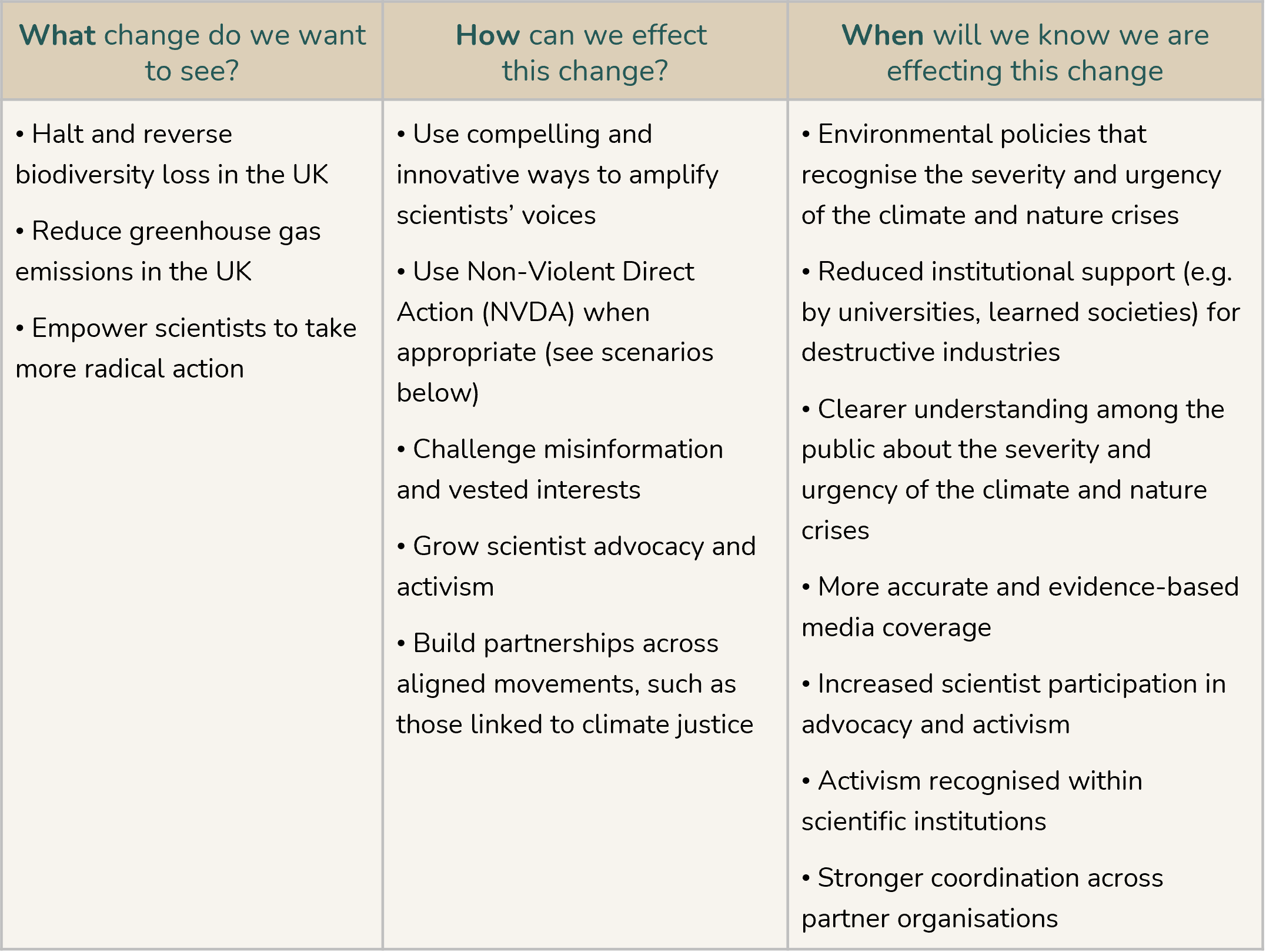
Different NVDA Scenarios
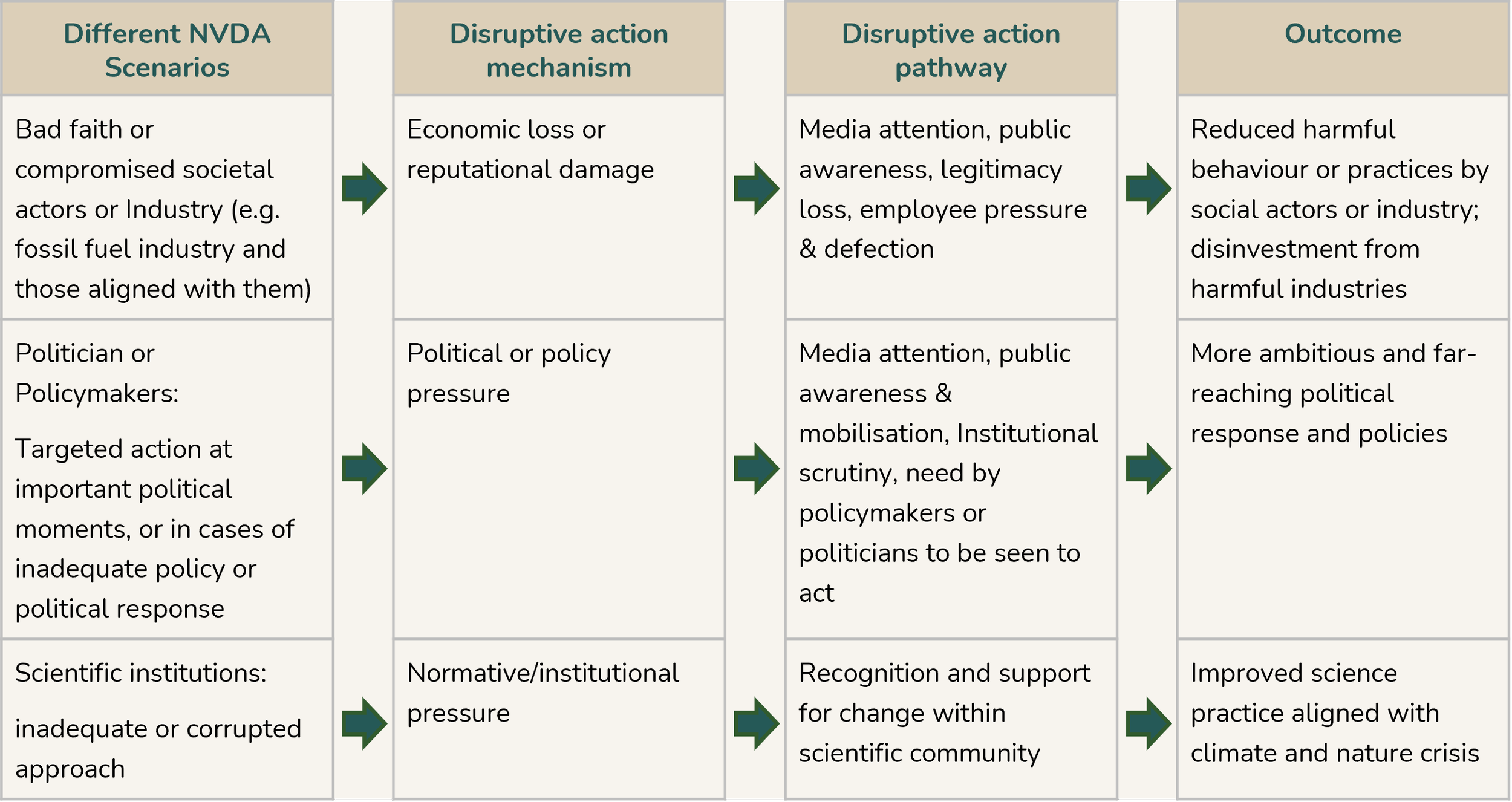
Examples
Science Museum, London
Fossil fuel sponsorship · Campaign 2019–2024

Photo Credit Andrea Domeniconi
Example of compromised societal actors: The Science Museum in London has been receiving sponsorship from three major fossil fuel companies BP, Shell and Equinor since the early 2000s, and in 2021 signed a new sponsorship deal with Indian coal conglomerate Adani.
In 2019, scientists launched a campaign alongside other partners that included publishing a book that was sent to trustees. The scientists' campaign involved a series of NVDA actions over the years, including locking themselves to exhibits, disrupting events and staging several overnight occupations, with vocal support from public figures such as Chris Packham.
Each action was covered by the media, bringing greater awareness among visitors and event participants. In late 2021, two trustees resigned from the board. Over the years, participants pulled out of events, forcing the museum in one instance to cancel an event at the last minute.
Although it can be difficult to attribute any outcome to a specific action, the scientists’ active campaign contributed to several beneficial outcomes:
-
Policy change
The Science Museum Group announced its adoption of the Transition Pathway Initiative (TPI) in November 2020, positioning itself as the first cultural institution to use the tool to assess sponsors' progress toward a low-carbon economy. The museum initially set a threshold of Level 3 on the index for sponsors, a standard that unfortunately allowed ongoing partnerships with companies like Shell, BP, and Equinor. However, in 2022, the museum updated its criteria to require Level 4 on the index and alignment with the Paris 1.5°C target by 2024. -
Sponsor drop
In 2024, the Science Museum dropped Equinor as sponsor after it failed to meet the museum's new criteria. -
Structural change
The Science Museum Group established a new "partnership panel" to review potential donors in 2023. This change came after Director Ian Blatchford had previously held sole decision-making power over sponsorships.
Department for Business, Energy and Industrial Strategy
Expansion of North Sea oil and gas - April 2022
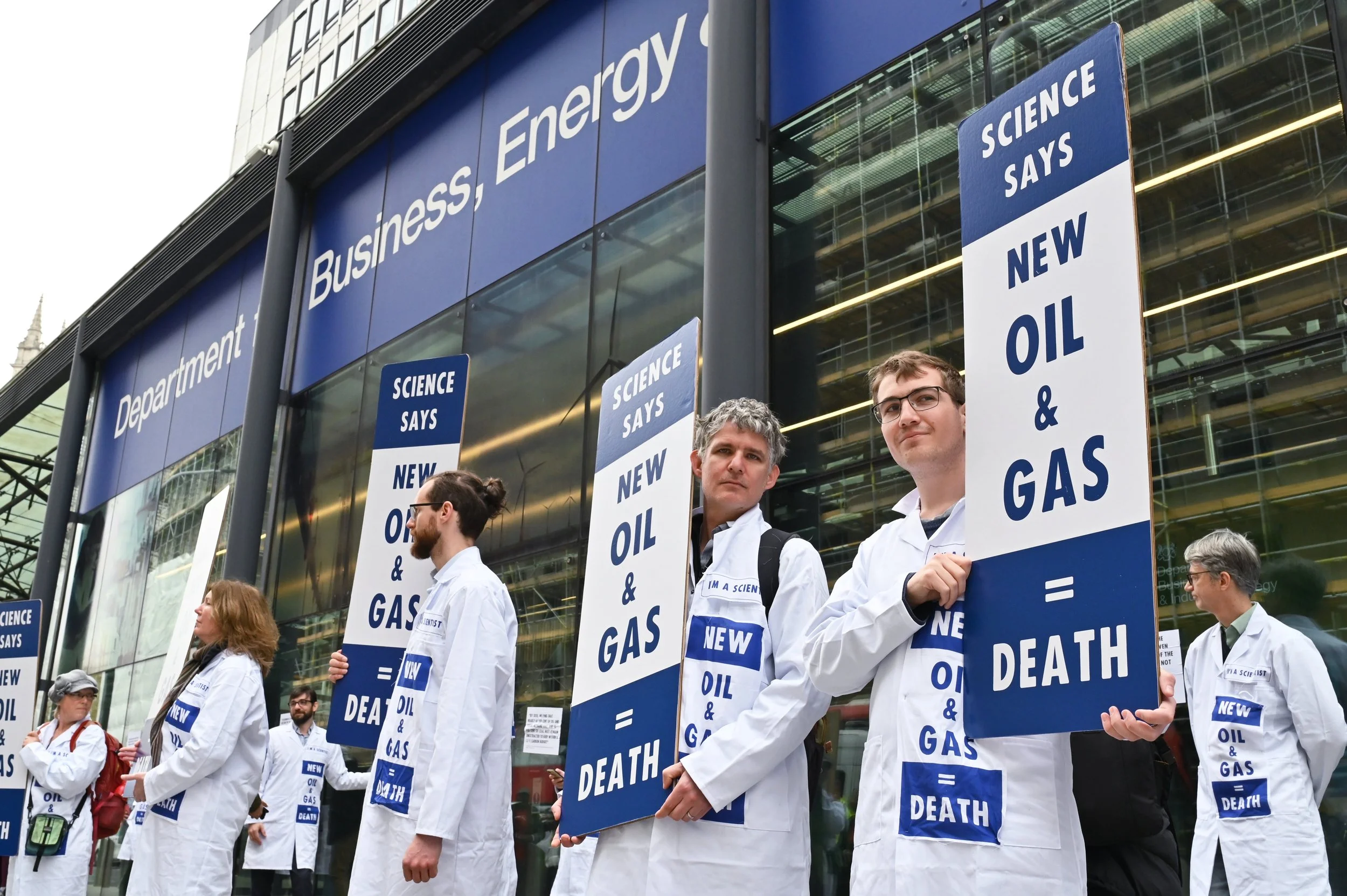
Photo Credit Andrea Domeniconi
Example of harmful policy: expansion of North Sea oil and gas. Action was targeted at an important political moment and focussed on a specific and harmful policy proposal. In early 2022, the UK government published a new energy strategy promising to continue the exploitation and expansion of North Sea oil and gas. This was despite clear warnings from scientists that this would breach the conditions required to limit dangerous climate change, as well as undermining international cooperation on climate action.
In April 2022, scientists pasted peer-reviewed papers and quotes from experts onto the windows of the UK Department for Business, Energy and Industrial Strategy (BEIS). These papers and quotes highlighted the contradiction between scientific analysis affirming the need to cease fossil fuel expansion, with the new policy position that had been announced. Having pasted these materials onto the windows of BEIS, the group of scientists then glued their hands to the glass to highlight the climate science the government was ignoring.
Widespread press coverage of the action, including the front page of The Guardian, brought direct attention from senior policymakers and politicians. Subsequent court cases and acquittals attracted further support from the wider scientific community and generated additional media coverage of the issues.
This action was just one among many forms of pressure applied to the government in order to counter pressure from vested interests; as such we can never know the exact degree of influence this particular action had. However, the government elected in 2024 subsequently adopted a position of refusing new licences which it maintained after taking office - a world-first and important win for climate activists.