
How scientists can act
"To secure a liveable future, each of us needs to ask ourselves: how can I best contribute at this crucial moment in human history?"
Fabian Dablander
Whether you're just starting to think about how to act or already looking for your next step, this page, curated specifically for scientists, brings together tips and resources to help you move from concern to action. Because knowing where to begin is often the hardest part.
Don't miss out: sign up for our monthly newsletter and seminar invitations.
A scientist's guide to hosting a People Emergency Briefing screening
In November 2025, the National Emergency Briefing brought leading experts to Westminster to present the latest evidence on the climate and nature crisis to politicians and other influential figures.
A 50-minute film captures the key evidence and public reactions to it. Screenings are designed not only to inform, but to spark discussion and action as part of a wider national conversation on climate resilience, nature loss and public preparedness.
To support screenings in universities, research institutes and learned societies, Abi Perrin has produced a guide with tailored resources and practical next steps for scientists and academic audiences.
Communicating Complex Crises
The Communicating Complex Crises toolkit, aimed at helping academics tell fuller, more honest stories about environmental/social harm and paths forward.
- Share your motivations
- Contextualise your expertise
- Platform others
- Share your experiences
- Reference real stories
Other resources
Atmospheric scientist Katharine Hayhoe explains why meaningful conversations begin not with facts and figures, but with shared values such as family, community and faith. (17 min)
Earth System Scientist and SoS member Aaron Thierry highlights the important points to acknowledge when discussing our climate concerns. (43 min)
Science communicator and SoS member Abi Perrin shares practical guidance on communicating science more effectively.

Photo Credit Kirk Pritchard. In May 2025, over 150 scientists gathered at Parliament Square to urge MPs to take the scientific consensus on climate and ecological breakdown seriously.
Often politicians lack a basic understanding of the severity and consequences of climate and ecological breakdown. One of our roles is to constructively engage politicians, (MPs and councillors) on the urgent imperative to prioritise transformative action.
Writing to them ensures they know which issues matter to their constituents. And as scientists, we have a critical role to play: politicians are more likely to take action when they perceive significant public pressure on a specific topic, and they need to understand the overwhelming scientific consensus on the urgency to act.
This guide, written as part of the "Bring Science to Politics" campaign, is full of tips and facts to support your engagement with policymakers.
To find your elected representatives, use Write to Them.
To know the voting record and other details for your MP, consult They Work for You.
For tips or training to engage more effectively with your politicians, consult Hope for the Future.
Bring sustainability into your journal club
Drawing on Kate Raworth's Doughnut Economics framework, Anne E. Urai and Clare Kelly developed a participatory workshop that reimagines academia within human and planetary boundaries. The accompanying guide provides practical advice for facilitators.
Why not try it at your next journal club?
Start a support network in your learned society
You might be surprised how many people would welcome a network that provides a safe space to share experiences, overcome barriers, and take action on the climate and biodiversity crises.
The British Ecological Society's CASCADE (Community for Activism and SCience-based ADvocacy in Ecology) Network supports ecologists who want to engage in environmental activism and advocacy.
'We held a workshop on advocacy and activism attended by over 130 delegates at the British Ecological Society's annual meeting: "A research career vs campaigning for change: a false dichotomy?" This led to a survey of members' attitudes towards activism, and the results were more positive than we had expected. We are now planning further events, including a session on activism at the upcoming BES conference.'
James
Professor of Ecology
Design assignments that make a difference
What if one assignment change could produce meaningful outcomes beyond the lecture theatre?
'I successfully changed my students' sustainability assignment to be a practical as well as an academic exercise. One student got her workplace to replace their plastic aprons with washable ones, which has now been rolled out across all their settings. Another student successfully applied for a grant to help a homeless charity set up a small growing area at a drop-in centre. A third student reworked the logistics of home-care workers so that they reduced their fuel use on home visits.'
Jane
Healthcare Science Lecturer at East Sussex College Hastings
Research for a Future toolkit
The Research for a Future toolkit, for researchers wanting their work to do less harm and contribute more to a fair, sustainable world.
- Does the science-society contract work?
- Orienting your research to support transformation
- Planning your research collaboration
- Securing funding for your research
Teaching materials
The Seed Library: Database of teaching materials to help shift education toward sustainability.
LEAF - Laboratory Efficiency Assessment Framework is a standard set by UCL to improve the sustainability and efficiency of laboratories. Join the 85 global institutions already taking part and help address the climate and ecological emergencies through your science.
My Green Lab offers trusted certifications, educational programs, and evidence-based resources.
The Sustainability of Science is a comprehensive handbook for research group leaders, laboratory technicians and facilities managers wanting to improve the sustainability of their research. It covers energy use in the laboratory, reducing single use plastics and wider considerations for facilities design.
'In our lab we have been able to replace some single-use plastic consumables quite easily. For example, we have gone back to using glass tubes for growing bacteria. My colleague doing the histopathology now uses reusable cassettes for tissue blocks and glass for collection tubes. Emissions have been reduced by using our in-house lab media services which means that the reagents we use are not being shipped from overseas.'
Lynn
Senior Researcher at the Institute of Cancer Research
Academia's deep-rooted reliance on international travel is something that will need to change if we are to make a real difference. Find out resources and articles here.
'In 2024, working closely with another colleague, we managed to get Sustainable Travel Leave (up to 2 extra days a year for flight-free travel) passed as a policy. This was initially adopted on a trial basis, but it has proved popular and is hopefully here to stay. To encourage others to consider flight-free travel, we ask staff who use the policy to write a short testimonial about their holiday, which we share in our staff e-newsletters. This helps colleagues see what is possible and know who they can speak to if they want to find out more about particular experiences. We have backed up the policy by holding events promoting green travel every June and ran a drop-in discussion session on flight-free travel around Europe. We also encourage staff to log their commuting miles by active transport during June, and people have been really creative with it. One of my colleagues even came in by train and paddleboard today!'
Viola
Science Communications for a Wildlife NGO
'While I was working at a semiconductor company in the UK, I needed to take four team members to the Netherlands for a meeting in 2022. The default assumption was that we would fly, but I suggested that we travel by train instead. Using the journey-planning advice available on Seat 61 to organise the trip. It showed me that simply encouraging colleagues to consider an alternative can be a good place to start.'
Tony
Semiconductor Professional
'Back in 2009, I remember being one of the first people to speak out about academic flying in my research group. This was awkward to start with, but over time attitudes changed and it became more normalised. Working together with others in the cross-university Tyndall group, we developed guidelines and points of principle for creating a low-carbon research culture. By the time the Centre for Climate Change and Social Transformations (CAST) was established in 2019, we had fully developed and uncontroversial policies for sustainable travel, as well as for procurement and catering. What had once been an awkward conversation had become standard practice, and the normal course of action was to travel overland to European conferences.'
Stuart
Senior Research Fellow in Psychology at a Russell Group University
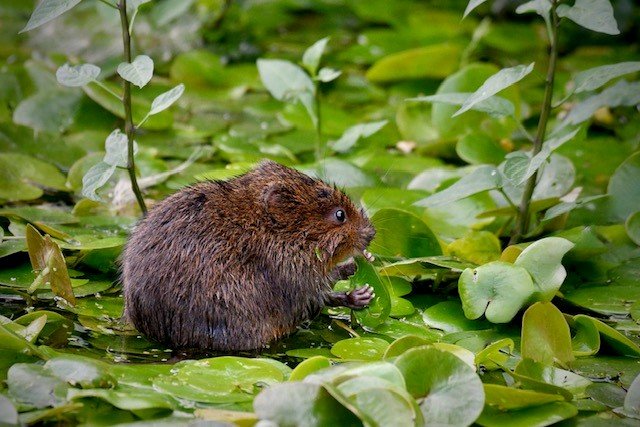
Photo Credit Harry Moore
Unite for Nature is a community of science-led nature activists and part of the SoS network. Through our chat group and monthly meetings, we share information, discuss key issues, and plan actions to protect and restore nature.
Whether you want to expand your knowledge, network, contribute your expertise, or find support among others who share your concerns, we welcome your involvement.
To express your interest, please email us.
go further
Social scientific evidence, as well as historical precedents, show that social movements can have great capacity to catalyse rapid transitions.
Courtesy of Louisa Jones
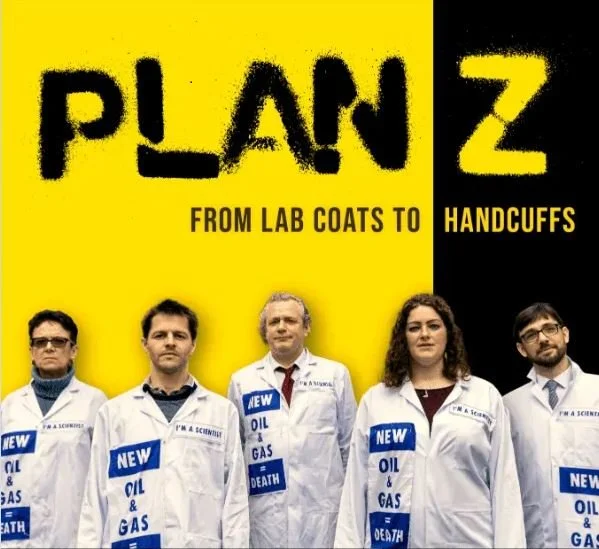
PLAN Z: From lab coat to handcuffs
Plan Z: From Lab Coats to Handcuffs is a 2024 short documentary film by directors Louisa Jones and Vladimir Morozov that gives us a window into the world of reluctant activism, and explores the power of protest when established routes of influence fail.
After a run at cinemas and film festivals, Plan Z is now available for everyone to watch.
Science activism in the literature
How scientists can contribute to the social movements essential to protecting climate and nature Perrin et al, 2025, npj Climate Action
Climate change engagement of scientists Dablander et al, 2024 Nat. Clim. Chang.
Actions speak louder than words: the case for responsible scientific activism in an era of planetary emergency Wyatt et al, 2024 Royal Society Open Science
Civil Disobedience by Scientists Helps Press for Urgent Climate Action Capstick et al, 2022, Nature Climate Change
Climate crisis and ecological emergency: Why they concern (neuro)scientists, and what we can do Rae et al, 2022, Brain and Neuroscience Advances
The biospheric emergency calls for scientists to change tactics Racimo et al, 2022, eLife
From Publications to Public Actions: The Role of Universities in Facilitating Academic Advocacy and Activism in the Climate and Ecological Emergency Gardner et al, 2021, Frontiers in Sustainability
Why scientists choose activism
Courtesy of Real Media
Charlie Gardner joins journalist Rachel Donald to discuss why scientists feel forced to choose activism. After decades of ignored data, warnings and suggestions, these same scientists who have been fighting to understand the crisis are taking to the streets to be heard. They discuss ecological systems, energy policy, corrupt politics, media, Extinction Rebellion, how to engage the public and how people can get involved in the face of disastrous inaction. Listen here.
Courtesy of Real Media
Aaron Thierry joins journalist Rachel Donald to discuss his research, explaining the positive impact of scientists rebelling against government inaction, and why all academics must broaden their understanding of their role as educators to warn their students of the realities of the crisis. He explains the benefits of a decentralised activist movement sharing one single coherent message—and, in doing so, reveals the true sunken cost of fossil fuel infrastructure that will likely send us well over the 1.5 degree limit. Listen here.