
What Can One Person Actually Do?

by Charlie Gardner

When Extinction Rebellion burst onto the scene in 2018 it felt like what I’d been waiting for, and I threw myself into activism. Soon our scientists’ group was formed and I found myself a useful niche, trying to persuade the rest of the academic community that they, too, might have greater influence if they stepped beyond ‘the lab’.

Seven years later I’m still at it, and I’ve never been more convinced about the importance of this work. But once the initial excitement of joining such an impactful social movement started to settle, it quickly became clear to me that not everyone was going to join XR. Many people don’t have the liberty to engage in protest, and many more simply don’t consider themselves activists, so most of the ‘silent majority’ who are worried about the breakdown of climate and nature just sit there, with no useful outlet for their anxiety.

It’s not that there’s nothing they can do. Yet most of the advice we ever hear is woefully inadequate, focused as it is on reducing our footprints, and fails to inspire. That’s always frustrated me so, when the IPCC published one of their synthesis reports in 2021, I wrote a long Twitter thread outlining all the other things we can do.

It went a bit wild. Lots of people said they found it useful, others appreciated my tone, and in time I started to play with the idea of turning it into a book. After what turned out to be quite the slog, that book’s now going to be published in January!

What One Person Can Do is the how-to guide for anyone who wants to do more for climate and nature. The friends I’ve shared it with in this group have loved it and I hope even the most experienced activists will draw a lot from it, but I didn’t really write it for us. I wrote it for our friends, family members, colleagues, neighbours and students who are worried, but haven’t yet found their power to do much beyond being careful with their shopping.   
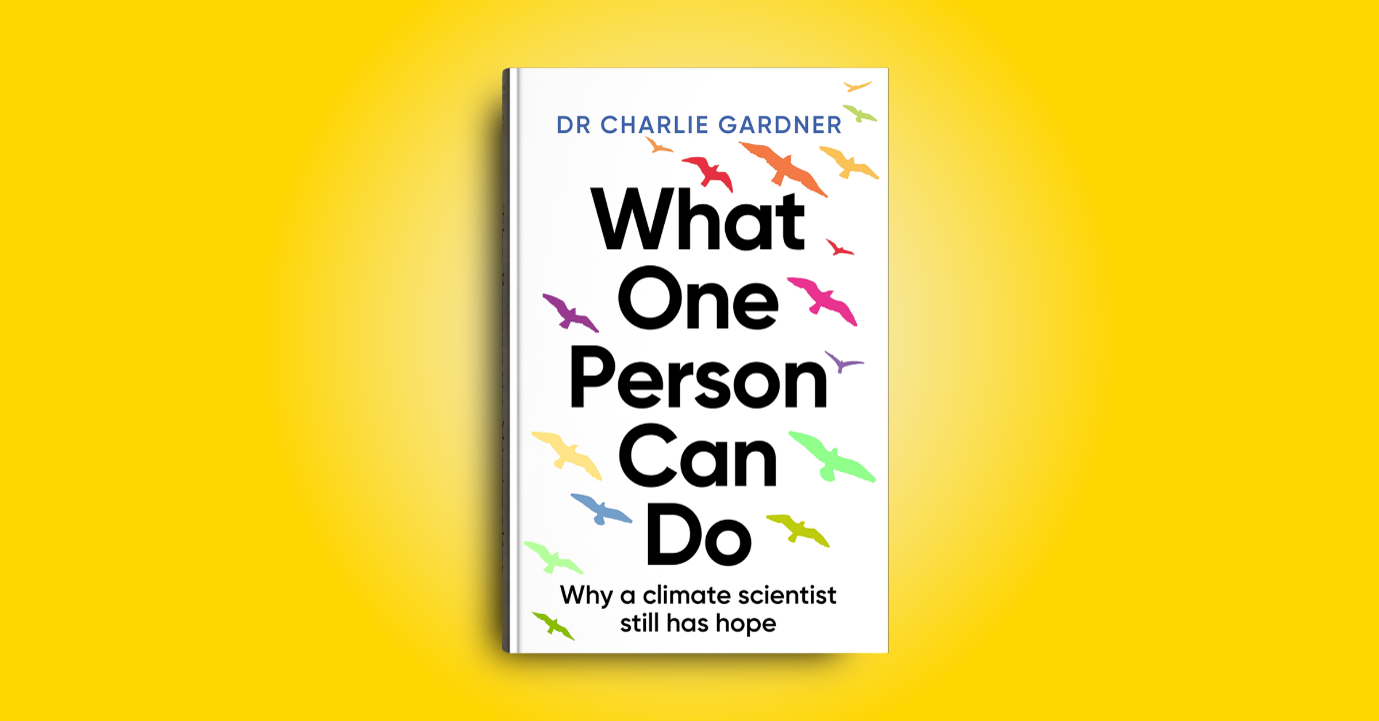
The book is framed around the idea of social contagion, and the fact that everything we do for climate and nature has a powerful double impact. Beyond the direct effects it also sends a signal to other people. It’s a signal that says ‘other people are taking this seriously, maybe I should too’, and it’s how we reach social tipping points.

The book has seven main chapters, covering:

  • How to cope with the enormity of it all and look after ourselves

  • How to reduce our footprints

  • How to speak persuasively with the people who matter to us

  • How to get together with likeminded people and take collective action as a group

  • How to make our communities more sustainable and resilient

  • How to transform our workplaces and the other organisations we’re part of

  • And, of course, how to push for system change through campaigning and activism.

It’s a book very much born from my time in Scientists for Extinction Rebellion, and now Scientists on Survival. Most of my thinking has been developed through resources you’ve shared, through conversations I’ve had with other scientist activists, and through the collective action we’ve taken together. The book wouldn’t exist without this group, and without so many of you, and I’m absolutely thrilled that you will soon be able to read it.

I don’t like having to play the salesperson, but I’d be really grateful if you’d consider pre-ordering a copy. I’m convinced this is a powerful tool, and I’m desperate to get into into as many hands as possible to help us reach social tipping points. Pre-orders will have a big role in that because they guide retailers’ decisions on stocking and promotion, so please have a look at some of the more ethical retailers here.
Please also get in touch if you’d like me to speak to your local group, students or workplace.

Thank you, happy reading, and more power to you! 
The National Emergency Briefing: a perfect entry point for scientist activists

by Tracey Elliott

Activism is not easy for many of us. Stepping out of our comfort zone - whether it's a lab, field station, office, or even home – can be unnerving.  Often more introvert than extrovert, scientists are trained to be focused, neutral and dispassionate.  In our pursuit of expertise, some of us have a tendency to be purist; manifestly feeling uncomfortable taking a stance on the climate crisis or on nature loss if we are not actually climate scientists or ecologists ourselves. In a thirst for new knowledge, objectivity can sometimes trump subjectivity.  This pursuit of expertise and of maintaining political and emotional detachment has arguably marginalised the science community from mainstream discourse, and risks undermining the urgency and legitimacy of what the science has been telling us for decades.  

Scientist activists recognise this risk of marginalisation and often support social movements campaigning for urgent and transformational societal change.  We do this as  experts or (more often than not) in our capacity as scientifically trained and data-literate citizens. One such social movement is the National Emergency Briefing (NEB).  The beauty of this initiative is (at least) fourfold: 

1. It is underpinned by up-to-date evidence of nine experts in key scientific disciplines and in economics and national security. 

2. It is very much of the moment with over 5,225 (and growing) screenings of its keystone film, the People's Emergency Briefing (PEB), nationwide. 

3. It is inclusive, secular and apolitical, bringing multiple communities together under one comprehensive, integrated banner of the climate and nature emergency.

4. It is well-resourced, providing a wealth of "how to" guidance and materials to organisers, hosts and facilitators across local communities, workplaces and - soon - schools. 

In short, activism is handed to us on a plate!  And if that wasn’t enough, our colleague, Abi Perrin, has produced tailored guidance to help academics screen the film in their own institutions (here).  The NEB provides the perfect initiation for a budding activist, the perfect refresher for a rusty one, and a positive breeze for a seasoned one; whether scientist or non-scientist.  If you are reading this, then you probably fit into one of these categories. 

I was fortunate to be able to attend the original NEB event in November 2025, when we heard from the experts firsthand (it was electrifying) and I have watched it grow these past 11 months.  In many ways, it has been a revelation for me, coming late in the day to activism. I have worked at the traditional science policy interface for 25 years or so, but I think the NEB is rare in that it makes a concerted effort to (1) look at the evidence base for the climate and nature emergency comprehensively, holistically and intelligibly, and (2) bridge the gap between people and politics, at scale.  It endeavours to inform and empower citizens to overcome their frustration, scepticism, fear and anger in today's politics and use their democratic and social power, together.  

In engaging with the NEB, I have connected with local, community activism.  I am a member of a diverse group of constituents, all united in our concern about the climate and nature emergency. We have forged ourselves, quite organically, into an effective organising team.  We've hosted three local screenings - in a church, cinema and community centre - and plan to do more.  I am now more aware of local initiatives and learning about local politics.  I feel more assimilated into my local constituency and, even with my limited scientific knowledge, realise I know more than many others about the climate and nature emergency thanks to my scientific training and data literacy, if not expertise per se.  I am also learning about the psychology of climate change and how people process difficult information in different ways, which helps make me a more tolerant person!  It’s an enriching experience in multiple ways, and apparently more relatable to family and friends than my career at the science policy interface ever was!

Thanks to the insight I have gleaned from Scientists on Survival and using the NEB as a tool for wider societal engagement, I am a more visible and (I hope) trusted “scientist”, and certainly a more active and engaged citizen. The perfect complement.

As the NEB approaches its one-year anniversary, support it if you haven’t already!  

And if you’d like to explore the how science activism and community engagement can complement one another, or share your own experience, then please register for our SoS zoom chat on Monday 9 November (here).

Why new oil & gas = more fires, more floods & more deaths

by Abi Perrin & Stuart Capstick

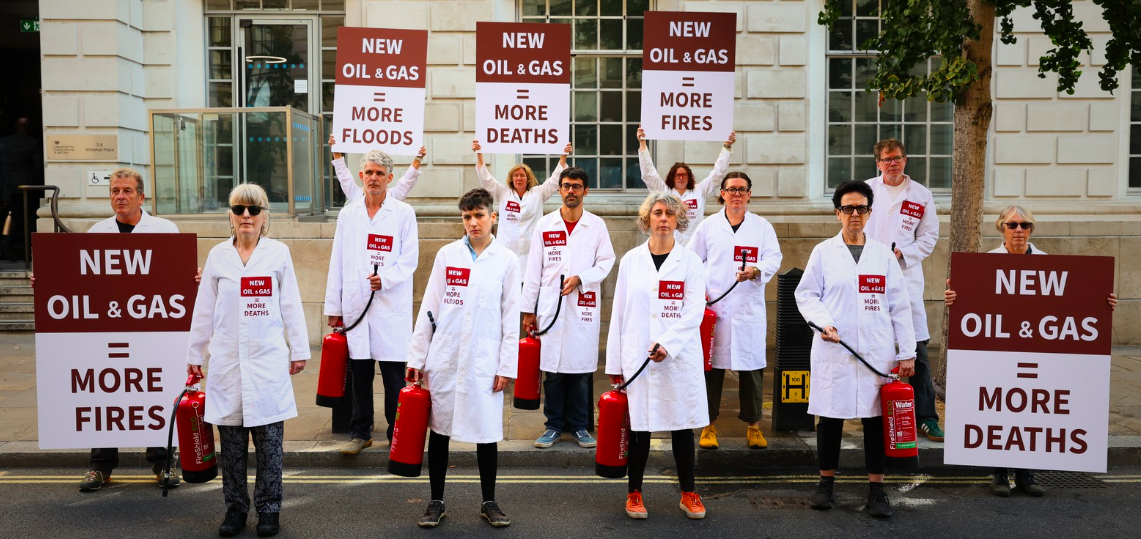
On August 17th, a group of scientists from Scientists on Survival took part in an action outside the UK Government's Department for Energy Security and Net Zero, to highlight the dangers and harms from permitting further oil and gas drilling.

Photo by Kirk Pritchard

The statements we use in our public actions have to be short and punchy, designed to encapsulate aspects of the scientific consensus about unfolding climate risks. They are stated as starkly, plainly and urgently as we can make them. At the same time, as scientists, we recognise that these statements must be supported by evidence. Here we share short explanations of the statements we have used, as well as links to further evidence that supports them.


Background

Greenhouse gas emissions, caused by humans, are causing average temperatures on Earth to increase. This is plain fact, supported by huge amounts of evidence and scholarship.

The rise in average temperatures has happened extremely rapidly since coal, oil and gas have been used at scale. Burning these fossil fuels is the biggest contributor to global heating and the resulting climate emergency.

"The evidence is clear that fossil fuels—and the fossil fuel industry and its enablers—are driving a multitude of interlinked crises that jeopardize the breadth and stability of life on Earth"

Scientists' Warning on Fossil Fuels (2025)

Extreme weather events are amongst the most noticeable symptoms of the climate emergency. Technical approaches known as 'attribution science' allow us to estimate how much more likely, more frequent and/or much intense global heating has made these extreme events. For example, a recent study provided evidence that fossil fuel emissions have rapidly worsened European heatwaves, concluding the extreme heat observed in June 2026 was "tens to hundreds of times more likely" than it would have been in 2003 and would have been "virtually impossible just 50 years ago".

Statement 1: New oil & gas = more fire

Global heating creates the hotter, drier conditions that makes fires more likely take hold, spread faster and burn longer.

Attribution studies have demonstrated that fossil-fuelled global heating has already made deadly wildfires much more likely. This includes detailed reports on the fires in Spain and Portugal, Turkiye, Cyprus and Greece and more widely across Europe in 2025.

"We found that human-caused climate change was a key driver of the fire weather conditions, primarily through its influence on exceptionally high temperatures, but also by exacerbating drought conditions"

World Weather Attribution on European wildfires (2026)

NASA data shows that extreme wildfires are getting bigger, more frequent and more intense. This trend is expected to continue as carbon emissions drive hotter and drier conditions in many parts of the world.


Statement 2: New oil & gas = more floods

Global heating increases the likelihood and impact of flooding by fuelling extreme rainstorms and rising sea levels.

A warmer atmosphere can hold more moisture, thus creating the conditions for heavier, more intense rainfall. Hotter oceans also fuel more intense tropical cyclones

"In Jamaica, we find that heavy 5-day rainfall events such as the one associated with Melissa are about 30% more intense and about twice as likely in today’s climate, that is 1.3°C warmer than it would have been without human-induced climate change. In Eastern Cuba the observations show an even stronger increase of about 50% in intensity and a factor 9 in frequency".

- World Weather Attribution on Hurricane Melissa (2025)

Ice melt and thermal expansion of the oceans is also causing sea levels to rise. This makes low-lying nations and coastal cities - including some of the biggest population centres on Earth - particularly vulnerable. Even under relatively conservative projections, large areas of major cities (including London) are expected to be below the annual flood level before 2050.


New oil & gas = more deaths

In addition to directly deadly extreme heat, fires and floods, global heating compromises the supply and accessibility of essential resources and services, including food, drinking water and healthcare.

"Climate change is increasingly destabilising the planetary systems and environmental conditions on which human life depends."

Lancet Countdown on health & climate change (2025)

Climate impacts kill, and no part of the world is immune to them anymore, as the recent heatwaves here in the UK have shown.

"More than 2,700 people are thought to have died from heat-related causes during the May and June heatwaves in England and Wales. Of those, it’s estimated that 42% died as a result of the extra heat caused by human-induced warming."

Met Office (2026)

Each extreme fire, flood, or heatwave comes with deadly, immediate costs to people and wildlife. Even so, the indirect, systemic impacts can be worse still. To give just one example, food security risks are mounting fast with climate impacts liable to compromise some of the worlds most important 'bread basket' regions all at once.

With so many variables at play across a complex, interconnected Earth system and so many possible courses our societies could choose to take, estimating loss of life due to climate impacts - especially those set to occur in the future - is far from straightforward. That said, even conservative estimates are terrifying: projections range from tens of millions to several billions of human lives expected to be lost from climate impacts, even in the near term (by 2050).

Using a 'Mortality Cost of Carbon' metric that attempts to estimate the temperature-related excess deaths that will be caused this century by today's carbon emissions, tens of thousands of lost lives can be ascribed to the new oil production currently being considered by the UK government.

"The analysis found that Rosebank alone could be linked to approximately 57,400 excess heat deaths globally over its lifetime – more than the number of babies born in Scotland in a year."

Oxfam (2026)

Note: Burning fossil fuels is also the biggest contributor to air pollution, which results in millions of deaths each year.

And so...

To fight the fires, hold back the tides and protect lives it is now extremely urgent - more so than ever before - that we:

  • Stop making the problem worse. This requires the UK government to show courage and leadership and to face down vested interests who wish to maximise their profits from the extraction and sale of fossil fuels. It requires cutting greenhouse gas emissions as fast as possible, via rapid and fair transitions in how energy, food and other materials are produced, distributed and consumed.

  • Avert the feedbacks and tipping points that massively and irrevocably escalate climate risks. Alongside cutting emissions, protecting and restoring ecosystems are essential to this.

  • Ensure our political and societal response is informed by science. For as long as we have a system where decision-making is influenced more by industry lobbying than it is by the presence of the sober analysis of existential risks, we will not have a system capable of protecting lives and livelihoods.

  • Adapt to the impacts we can no longer avoid. Our systems and infrastructure were not built for the magnitude nor the speed of change we are experiencing as our climate system breaks down. We can no longer depend on them (as even the UK's own climate advisors warn).

  • Work together. Denial, delay and division have already come at far too great a cost. Communities like ours - Scientists on Survival - exist to help empower one another to find our role in a society-wide response proportionate to the Emergency we face.

On science, activism & public trust

Abi Perrin, Charlie Gardner & Stuart Capstick 

Public trust in science is essential to ensure public health and safety, sustainable behaviour changes and support for evidence-based policies. This trust has been consistently high but has begun to break down in some settings.

Recent years have also seen a surge in research and academic interest into public trust in science, stimulated at least partly by scientist involvement in popular climate movements.

Much of this literature focuses on the role of scientists and the potential risk to public trust if scientists engage in advocacy or activism. However, the rationale, motivations and evidence used by scientist activists themselves are often neglected in these discussions.

Here we briefly share some of those perspectives, reflecting on what critiques around the relationships between science, activism and public trust often miss. 


Public trust has been intentionally undermined

Arguments that focus primarily on scientists as influencers of public trust often fail to consider other drivers of recent shifts. 

Most importantly, they ignore the existence of organised, longstanding efforts to undermine public trust in science.  These include industry-driven science denialism from tobacco and fossil fuels to big meat, as well as attacks on integrity of scientists and scientific institutions (e.g. Climategate and the ongoing actions of US political administrations). 

Misinformation has proliferated and spread wildly online, and is often amplified by hugely influential individuals who do not have protecting the public at the top of their agendas. 

Scientists themselves are not necessarily blameless here: whilst a very small minority have actively contributed to muddying the waters and spreading misinformation (some examples here), the broader scientific community’s reticence or failure to engage proactively, clearly and effectively with wider society has arguably left science more vulnerable to attack.


Passivity carries enormous risk

Various commentaries by high-profile scientists have positioned activism by scientists as misguided or irresponsible.  They have argued that it undermines public trust in science, for example because scientists should be 'neutral' (see below).

But what these arguments usually overlook are the huge risks of scientists appearing passive in the face of the existential threats our wider community has been warning about for decades. If, with all the privilege scientists have, we aren't seen to be taking urgent action, how can we expect the same of others? And how can we expect scientists to be trusted, if we aren't aligning our actions and our knowledge?

Science, politics and values are connected

The idea that science is or should be politically neutral does not stand up to much scrutiny. Decisions about what science is funded and thus what questions science seeks to answer are heavily influenced by governments and industries.  Many fields, from medicine to conservation science, do not exist to generate knowledge for its own sake, but do so for the betterment of society and its goals. 

The evidence generated by science informs our beliefs, including those about the validity and potential harms of specific policy positions: much as pulmonology research shows us that cigarette smoking endangers public health, climate & ecology research shows us that current policies put us firmly on track for catastrophic impacts and devastating loss of life.  

While scientists should always be objective in their treatment of data and analysis, this should not be conflated with an obligation to remain silent or value-neutral about the implications of our findings (something which is in any case “unattainable and undesirable”). 

So what?

As climate and ecological breakdown and its impacts escalate, the stakes could not be higher: evidence and truth can - and must - inform a collective response that saves lives, whilst a rejection of them can only lead to accelerating division and collapse. Investing in the former requires courage, creativity and action from scientists, and this is what the SoS community exists to empower. 


Further reading